WHAT IS THE PLAY THERAPY?
DEFINIZIONE PLAY THERAPY
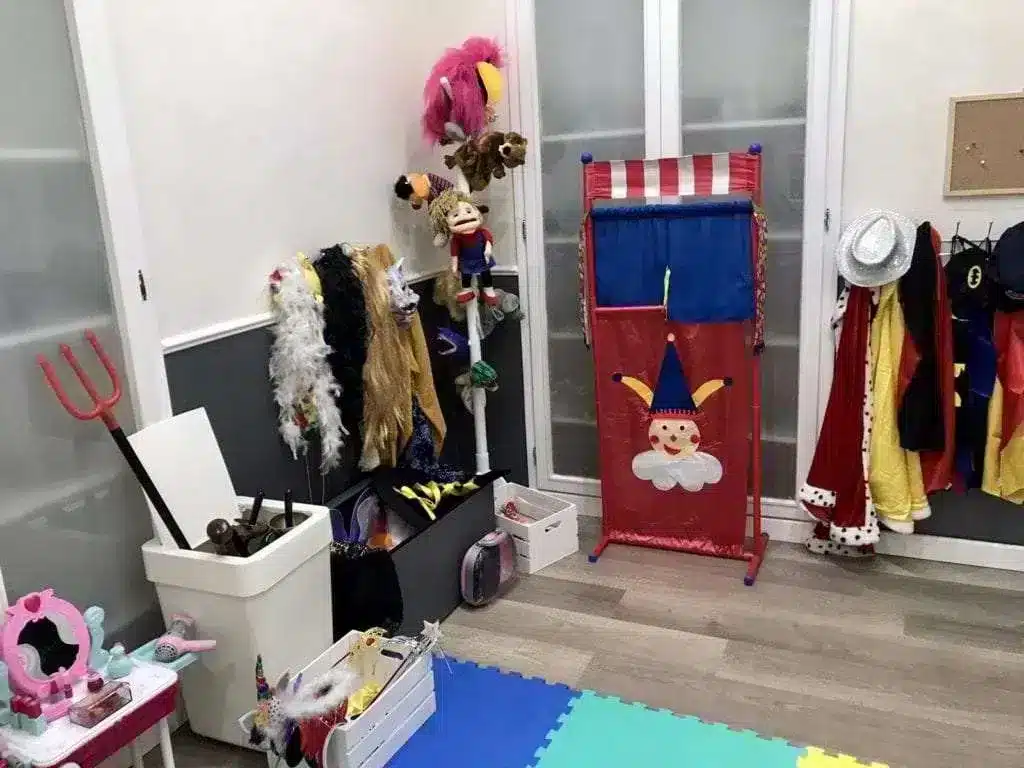
Play Therapy is the strategic use of play within therapeutic contexts to promote the expression and processing of the child’s thoughts, needs and feelings.
Although play has always been recognized as a means of communication, understanding of the child and development of the therapeutic relationship, Play Therapy is a paradigm that has developed evolutionarily within different theoretical orientations that present similarities and differences in their approach which is distinguished such as Directive Play Therapy and Non-Directive Play Therapy.
Cognitive Behavioral Play Therapy (CBPT) is included among the directive approaches.
TYPES OF PLAY THERAPY
DIRECTIVE Play Therapy
Directive Play Therapy uses play to create a strong bond between therapist and child.
Play Therapy NON-Directive
Non-Directive Play Therapy is an effective, non-intrusive therapy that takes place with children.
Historically, play therapy has been based on either psychodynamic or client-centered theories, such as Child-Centered Play Therapy (Axline, 1947). CBPT is different from these more traditional forms of play therapies, but has similarities to them in its reliance on a positive therapeutic relationship, use of a play as a means of communication between therapist and child, and therapy as a safe place.
Several important areas of differences involve: the focus on CBPT on directions and goals, choice of play materials and activities, play as educational, and the importance of making connections between the child’s behavior and thoughts.
SIMILARITIES/DIFFERENCES WITH THE TRADITIONAL PLAY THERAPIES
Knell (2009) describes the most salient similarities and differences between these two approaches, grouping them into: direction and objectives of therapy, play materials and activities, educational value of play, interpretation of the child’s play and role of praise. Obviously this description may be extremely reductive of the Play Therapy paradigm, but it gives an idea of the aspects that will be better described in the specific pages.
DIRECTION AND GOALS OF PLAY THERAPY
Non-directive play therapy values children as they are, without external demands, and avoids giving directions. In CBPT, however, we define therapeutic goals, and the foundation of intervention involves directing actions toward these goals.
PLAY THERAPY ACTIVITIES AND PLAY MATERIALS
In non-directive play therapy, kids pick play items and activities, and decide how to play. In CBPT, both the child and therapist make these choices.
PLAY AS EDUCATION
In non-directive play therapy, we view education as unsuitable due to its classification as a form of direction. In CBPT, we use play to teach alternative and more adaptive skills and behaviors.
INTERPRETATIONS AND CONNECTIONS
In non-directive play therapy the therapist does not interpret the child’s play but communicates their absolute acceptance.
The CBPT therapist explains the child’s play, helping them discuss conflicts and important matters.
PRAISE
In non-directive play therapy, practitioners avoid praise to prevent the child from feeling unaccepted and to avoid hinting at a need for change. In CBPT, praise is a crucial component of therapy. Praise communicates to the child which behaviors are appropriate and reinforces these behaviors to the child.
RESEARCH ON THE EFFECTIVENESS OF PLAY THERAPY
Research on Play Therapy, in general, supports the effectiveness of this therapy. In particular, there are studies that demonstrate its effectiveness on a wide range of social, emotional, behavioral and learning problems, including post-traumatic stress disorder, conduct disorder, depression, attention deficit disorder and hyperactivity, destructive behaviors, aggression, anxiety/fear, impulsivity, low self-esteem, reading difficulty, academic performance and social withdrawal. Finally, research also supports the cross-cultural effectiveness of this therapy and its beneficial outcomes with a wide range of populations, including children who have experienced chronic illness, grief and loss, physical/sexual abuse, domestic violence, adoption disruptions, and parental issues attachment, natural disasters, and stress related to life factors such as divorce and relocation (Bratton & Ray, 2000; Drewes, 2006; Ray & Bratton, 2010; Reddy et al., 2005; LeBlanc & Ritchie, 2001).
WHAT PROBLEMS CAN BE SOLVED WITH CBPT?

Selective Mutism

Specific Phobia

Oppositional Defiant Disorder

Obsessive Compulsive Disorder

Attention-Deficit/Hyperactivity Disorder (ADHD)

Generalized Anxiety Disorder

Childhood Depression

Childhood Anger

Elimination Disorders
ENHANCE YOUR CHILD PSYCOTHERAPY SKILLS
COGNITIVE BEHAVIORAL PLAY THERAPY TRAINING