Expressive arts in CBPT
Within the CBPT setting, creative and artistic activities are combined with cognitive-behavioral techniques to help children express, explore and modulate emotions that words alone cannot reach.
Giving shape to what has no words
Children have limited cognitive and verbal skills that can prevent them from understanding and communicating feelings whose nature is abstract and complex. Expressive arts offer the confidence and freedom a child needs to express themselves: when they play, draw and create, they feel comfortable, and the therapeutic relationship is established more easily.
One of the clinician’s central goals is to help the child identify, label and understand emotions — providing the tools to get in touch with their emotional experience and gain greater mastery of it. The act of creating with one’s hands is less threatening than talking directly about upsetting thoughts or events, and lets the child relax their defenses while engaging with therapy. This use of expressive arts within CBPT builds on the wider tradition of Cognitive Behavioral Play Therapy.
Materials — collage, painting, sculpture, clay, writing, book creation — turn the child’s inner experience into something visible and tangible.
Where art meets cognitive-behavioral technique
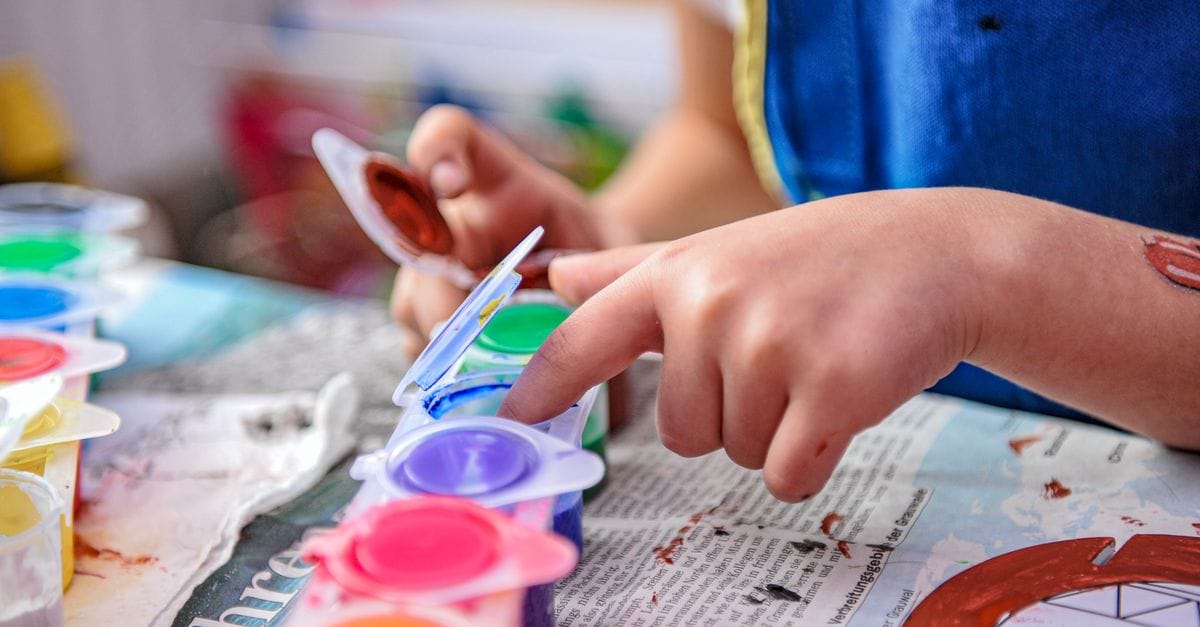
In CBPT, cognitive-behavioral techniques are integrated with expressive arts to facilitate contact with emotional and sensory states, their acceptance and their modulation, reinforcing the sense of self and self-efficacy. The arts encourage self-expression, develop coping skills and control, promote self-esteem and self-awareness, and reduce suffering.
- Structured materials (pencils, markers) support the verbal tasks of CBT and help represent thoughts
- Less structured materials (clay, watercolors) support physical tasks such as deep breathing and relaxation
- Drawing facilitates a child’s verbal account of emotionally laden events (Malchiodi, 2003)
From cognition to image, and back
If images are an essential element of cognition, then drawing and other visual means give a visual form to internal cognitive thoughts (Rosal, 2001). Art facilitates the acquisition of new ideas: creating an image tied to a life situation opens an opportunity for problem-solving, helping the child recover their cognitive maps and connect external and internal worlds so that behavioral change can be facilitated.
The process of making art is sensorimotor — an embodied window of expression when words fail (Hinz, 2006). It offers a language for expression where abstract thinking is still developing, producing an artwork that can later be processed and reflected upon together with the therapist.
It is not about drawing well or making a “nice” artwork — it is a process of self-discovery through any form of art that comes from an emotional experience.
Learn to use expressive arts in practice
A dedicated course teaches how to organize creative and expressive activities within the CBPT setting, choose the right materials, and integrate them with cognitive-behavioral technique along the therapeutic path.
Explore the Expressive Arts course →Train in the full method
Expressive arts are one of several CBPT tools. Browse the complete catalogue of professional courses for clinicians.
Browse all coursesStart with the method
Download the free ebook on Cognitive Behavioral Play Therapy.
Get the free ebookExplore the Expressive Arts course