Obsessive Compulsive Disorder: Cognitive Behavioral Play Therapy
ADVANCE YOUR CHILD PSYCHOTHERAPY SKILLS WITH COGNITIVE BEHAVIORAL PLAY THERAPY

What is Obsessive Compulsive Disorder?
Obsessive-Compulsive Disorder (OCD) is a psychopathological condition common in both adults and childhood. It is a severe, disabling, and often chronic disorder characterized by uncontrollable, repetitive, and ritualistic thoughts and behaviors that cause distress and impairment. It is defined by the presence of obsessions and/or compulsions. Obsessions are recurrent and persistent thoughts, ideas, sensations, worries, or images that are typically experienced as intrusive and unwanted. Compulsions are behaviors or mental acts that the individual performs repetitively in response to obsessions, in an attempt—sometimes ineffective—to reduce the anxiety provoked by the obsession.
Clinically significant obsessive-compulsive behaviors differ from developmentally appropriate ritualistic and repetitive behaviors in terms of severity, the distress they cause, and their negative impact on the child’s and family’s development and functioning.
Young children may be unable to articulate the reasons for these behaviors or mental acts. Finally, OCD is one of the most common disorders in developmental age, with an estimated prevalence around 3%.
How does Obsessive Compulsive Disorder present?
Children with OCD typically present with two or more symptom clusters, which may include fears of contamination, aggressive or catastrophic obsessions, religious or scrupulous obsessions, and somatic obsessions. Obsessions may present as intrusive thoughts; the child may express them through repetitive questioning. By definition, obsessions cause distress.
Most children with OCD present multiple compulsions. The most common compulsions are washing, checking, repeating, rituals involving other people, ordering and arranging, tic-like compulsions, counting, tapping, and rubbing. Compulsions are usually linked to obsessive thoughts and are performed to reduce anxiety and distress. In other cases, the compulsion is performed to avoid imagined harm.
Often children lack the verbal skills to express their internal states or to describe why they are performing specific compulsions.
It is important to specify that for an OCD diagnosis, obsessions or compulsions must consume time (for example, more than one hour per day) or cause clinically significant distress or impairment in social, school, or other important areas of functioning.
When does Obsessive Compulsive Disorder occur?
Recognizing and correctly diagnosing OCD in developmental age is complex and depends on several factors. First, some stereotyped behaviors are part of normal child development. Therefore, it can be difficult for parents and teachers to distinguish between normality and pathology and to decide when to seek specialist consultation. Additionally, children and adolescents with OCD tend to hide their symptoms even from close family members, which complicates early identification. Finally, children often have less insight into their disorder than adults and do not recognize their symptoms as problematic.
Onset of OCD in childhood can be sudden or gradual. Children with gradual onset tend to present an earlier onset. OCD symptom types and patterns can change over time. The course of OCD in childhood varies, although persistence of the diagnosis or partial presence of symptoms is common. Some children show a chronic course, while others present episodic manifestations.
What are the causes of Obsessive-Compulsive Disorder?
Among the causes of OCD we can identify three groups of factors:
- Temperamental factors: higher internalizing symptoms, greater negative emotionality, and behavioral inhibition in childhood are possible temperamental risk factors.
- Environmental factors: physical and sexual abuse in childhood and other stressful or traumatic events have been associated with increased risk of developing OCD. Some children may develop a sudden onset of obsessive-compulsive symptoms associated with various environmental factors, including different agents and a post-infectious autoimmune syndrome.
- Genetic and physiological factors: the rate of OCD among first-degree relatives of adults with OCD is about twice that of first-degree relatives of adults without the disorder; however, among first-degree relatives of individuals with childhood- or adolescent-onset OCD the rate increases up to tenfold. From a neurobiological perspective, the cortico-striato-thalamo-cortical circuit appears implicated. Structural neuroimaging studies have shown anomalies in the orbitofrontal cortex, anterior cingulate, and striatum.
Obsessive Compulsive Disorder and Cognitive Behavioral Play Therapy
The Cognitive Behavioral Play Therapy (CBPT) approach aims primarily to modify behaviors and thought patterns.
CBPT is a structured, brief, goal-oriented therapy whose objectives are shared with the child and family. The child is welcomed into a play setting designed to create the therapeutic alliance, and parents follow a parallel pathway aimed at learning and strengthening parenting competencies.
The intervention is organized into the following phases:
- ORIENTATION PHASE: This is the initial phase of CBPT. Significant emphasis is placed on preparing both the child and the parents. It is crucial to organize an initial meeting between the therapist and the parents, without the child present, to examine the child’s history and background information in detail. This allows parents to share their perception of the child’s problem. During these initial meetings, the therapist assists parents in preparing the child for the first session. In this phase, the ongoing role of parents and other significant adults in the assessment and treatment process is also explained. Although attention is focused on the child during CBPT, the therapist continues to interact regularly with the parents to offer support and to evaluate progress toward therapeutic goals.
- ASSESSMENT PHASE: This phase focuses on collecting crucial information to establish therapy goals. In addition to interviews with parents, a key element is observation of the child’s play. During this phase, various instruments are used, including questionnaires administered to parents, assessment of the child’s play, assessment of family play, the puppet sentence-completion task, and other measures personalized by the therapist. The therapist may establish a baseline for the frequency of the child’s behaviors, allowing evaluation of behavioral changes over the course of treatment.
- CASE CONCEPTUALIZATION PHASE: CBPT begins with analysis of the data collected during the child’s assessment, with the aim of planning an effective treatment and providing a logical structure for the development and achievement of therapeutic goals. The therapist starts by explaining OCD, analyzing individual, relational, and environmental factors related to the parents’ concerns. The emotional side, thoughts, physical sensations, and coping strategies used by the child are examined. This phase also includes analysis of protective, risk, and maintaining factors that contribute to the child’s behavior.
- INTERVENTION PHASE: The intervention phase of CBPT focuses on using CBT techniques that help the child with OCD develop more adaptive responses to problems, situations, and stressors. The emphasis is on learning more adaptive thoughts and behaviors. Methods used include modeling, role-playing, bibliotherapy, generalization, and relapse prevention. Interventions are often traditional cognitive techniques adapted through play tools such as drawing and expressive arts, listening to stories with therapeutic protagonists (therapeutic storytelling), or interacting with puppets that face similar situations. Treatment includes interventions aimed at helping the child generalize behaviors learned during sessions to other contexts and working on relapse prevention. Although the primary focus is on the child, it is important to maintain regular meetings with parents to monitor progress, assess and intervene in parent–child interactions, and provide guidance on areas of concern.
- CONCLUSION PHASE: Both the child and the family are actively involved in the final phase of therapy. During this final period, the child addresses feelings related to the end of therapy while the therapist highlights the changes that have occurred and consolidates the learning process. Final sessions may be extended over time, moving from weekly to biweekly or monthly meetings. This helps the child perceive their ability to manage life without the therapist. The therapist positively reinforces the child’s progress between sessions and seeks to normalize the experience of separation. Follow-ups are scheduled after the conclusion of the intervention at 3 months, 6 months, 12 months, and 24 months to verify the effectiveness of the intervention.
What are the Therapeutic Goals?
In CBPT, goal-setting is shared with the child and their family. The aim of therapy is to teach skills that will help the child understand, think about, interpret, and respond effectively to events in their world, thereby escaping negative thought and behavior patterns. In the context of Obsessive-Compulsive Disorder, the following objectives are generally pursued:
- Develop emotion regulation capacities
- Direct teaching of anxiety management and self-regulation techniques
- Develop problem-solving skills
- Psychoeducation for both parents and the child. It is essential that parents understand this distinction when they begin to comprehend the specific challenges their children face. Even more importantly, both parents and the child should start with the awareness that the child is not responsible for the disorder, that symptoms are separate from who the child is as a person, and that all stakeholders (e.g., parents, teachers, therapists) assume responsibility for addressing current struggles.
For this disorder, the protocol by March & Mulle (1995) is typically adapted and carried out over 16 weeks.
- Week 1: establish a neurobehavioral structure.
- Week 2: make OCD the problem; introduce cartographic metaphors.
- Week 3: generate a stimulus hierarchy; identify and teach the transition zone.
- Weeks 4–15: anxiety management training.
- Weeks 1, 6, 12: parent–child sessions.
- Week 16: graduation ceremony.
- Week 22: booster session.
Each session includes review of the previous week, reaffirmation of goals, presentation of new information, selection of exposure “targets,” practice of relapse prevention, and assignment of homework for the following week.
What can Parents do?
It is essential that parents understand the factors contributing to the child’s symptoms, the environmental cues and events that trigger mood changes, and behavior management strategies that enhance self-esteem rather than shame the child.
- Parents should be taught the principles of the collaborative problem-solving approach (Greene, 2014). This approach allows both parent and child to express their desires and needs and models a problem-solving method that respects both points of view in reaching a solution.
- The intervention increases positive outcomes by incorporating a Playbook of practical activities and promoting engagement outside therapy. Parents are provided with a Playbook that gives weekly instructions for play-based practical activities, along with a copy of the treatment plan and the therapeutic work agenda. The Playbook also contains worksheets to monitor obsessive statements and compulsive behaviors and tools to measure the intensity of intrusive repetitive thoughts. The Playbook thus becomes the family’s transitional object to use and reinforce therapy skills in the child’s world.
- Parental participation in the child’s sessions is fundamental.
ENHANCE YOUR CHILD PSYCOTHERAPY SKILLS
COGNITIVE BEHAVIORAL PLAY THERAPY TRAINING
Parent Training in Obsessive Compulsive Disorder
What is Parent Training?
Parent Training is a competence-based intervention model that starts from the assumption that families are capable of managing and addressing the problem, that all families have strengths, and that they can learn.
Parent training embedded within Cognitive Behavioral Play Therapy emphasizes the importance of involving parents in the playroom setting, where they have the opportunity to observe and progressively implement interventions to shape adaptive behaviors in the presence of the therapist. It highlights parents’ adaptability and learning capacity and aims to modify relational styles and attitudes that negatively influence children’s behaviors.
What Parents can gain?
Through this approach, parents have the opportunity to:
- Learn new skills
- Acquire and practice specific techniques
- Receive individualized, ongoing feedback from the therapist to help them become more aware
- Learn to interpret more accurately their children’s emotions, concerns, and communication as expressed through play
This program, called PARENT TRAINING CBPT, follows an integrated and innovative approach founded on the following frameworks:
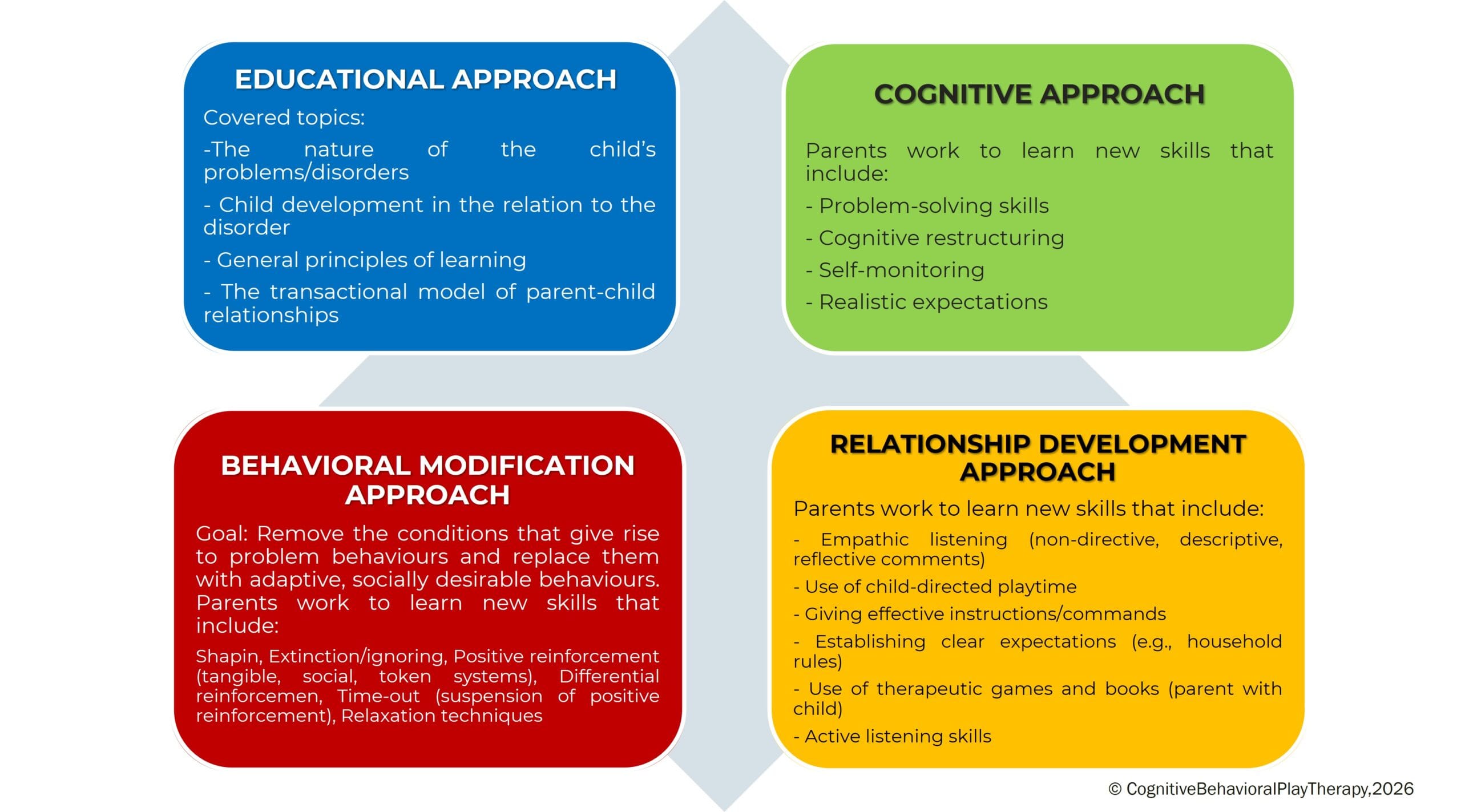
How is the Parent Training structured in Cognitive Behavioral Play Therapy?
Although the primary work is with the child, it is important to meet periodically with the parents. Parental involvement in Cognitive Behavioral Play Therapy is essential both during assessment and throughout treatment. A parallel pathway to the child’s therapy is planned, emphasizing the fundamental role of parents in influencing their children’s maladaptive behaviors. Parents are often encouraged to strengthen and reinforce the child’s adaptive behavior so that treatment continues outside the therapy setting (e.g., they are trained to use appropriate reinforcement for adaptive behaviors and extinction for maladaptive ones).
Target population: Intended for both parents.
Duration: Typically 6 to 14 sessions, organized as one weekly session of 1 hour.
Program phases
- ASSESSMENT PHASE: The problem is analyzed, parenting style is adapted, and therapeutic goals are defined. In this phase parents receive information about the causes and consequences of their children’s dysfunctional behaviors and learn to establish clear and consistent rules.
- LEARNING PHASE: This phase focuses on teaching new learnings of all the fundamental skills needed to support the child’s change. Parents have the opportunity to learn and practice techniques through practice sessions in which the therapist role-plays the child, guiding and instructing the parents. In particular, work focuses on:
- Mastery of prerequisites
- Modeling of skills
- Role-playing
- Errorless learning
- Successive approximations (shaping)
- Feedback (verbal and social reinforcers; token economy)
- Practice
- PRACTICE PHASE: In this phase parents conduct play sessions with their own children to put the learned skills into practice. Parents learn to recognize and prevent situations that trigger their children’s difficult behaviors and to use the same problem-solving strategies across different situations. After initial practice moments with the therapist, parents begin to run play sessions individually with their children under the therapist’s supervision.
- FEEDBACK AND GENERALIZATION PHASE: Parents discuss with the therapist the play sessions carried out at home to learn how to generalize what they have learned. Strengths and any problems that arose are reviewed. In this phase the therapist helps parents generalize all learned interventions and the parenting skills acquired during training. Each week some time is dedicated to applying techniques in everyday life, and homework assignments are given to practice the strategies.
- CONCLUSION PHASE: This phase occurs when therapeutic goals have been met and parents have achieved a satisfactory level of competence regarding play activities and parenting skills. Therapy is often tapered gradually, reducing session frequency to alternate weeks, then monthly, and so on.
Objectives of Parent Training
Specific goals of work with parents include:
- Increase understanding of the child’s problematic behavior
- Establish more realistic expectations
- Enhance warmth, trust, and acceptance toward the child
- Recognize the importance of interaction through play
- Communicate more effectively with their children
- Develop greater parental confidence and reduce frustrations experienced with their children
- Cultivate greater patience to form more realistic expectations
- Discuss personal reactions with the therapist to develop deeper understanding of one’s own feelings and behaviors
- Learn to become effective problem solvers of family conflicts and increase motivation for change
Bibliography – References
American Psychiatric Association (2013) Diagnostic and Statistical Manual of Mental Disorders Fifth Edition DSM-5 Italian translation.
Favaro A., Sambataro F. 2021 Manuale di psichiatria. Piccin.
Geraci M. A. 2022 La play therapy cognitivo-comportamentale. Armando Editore.
Geraci M. A. 2023 Comprendere il mondo dei bambini giocando. Armando Editore.
Geraci M. A. 2024 Il mondo della dottoressa Lulù. Collana Amzon CBPT Books.
Greene, D. (1977). Social perception as problem solving. In J. S. Carroll & J. W. Payne (Eds.), Cognition and social behavior (pp. 277–283). Psychology Press.
Knell S. M. 1993 Cognitive Behavioral Play Therapy J. Aronson.
Pandolfi, E. (2010). I Disturbi Esternalizzanti nell’Infanzia: fattori di rischio e traiettorie di sviluppo. Semestrale. a cura degli studenti della Scuola di Specializzazione in Psicoterapia Cognitiva e dell’Associazione di Psicologia Cognitiva, 50.